Julien Hequembourg Bryan, an American photographer and filmmaker, was born on 23 May 1899 in Titusville, Pennsylvania. He showed the world the heroic stance taken by the people of Warsaw in September 1939 and the scale of the German invasion.
In 1917, as a volunteer ambulance driver, he was sent to the front in France during the battles of the Argonne and Verdun. In the interwar years, he began working as a photojournalist and travelled extensively throughout Europe. In 1936, he visited Poland: Gdynia, Warsaw, Katowice, Kraków and Zakopane. In March 1937, during a seven-week stay in the Third Reich on assignment for the New York weekly Time, he produced the 16-minute film *Inside Nazi Germany*, directed by Jack Glenn, depicting German society manipulated by Goebbels’ propaganda and the emerging cult of Hitler.
The outbreak of war found Bryan in Europe. On 7 September 1939, he reached Warsaw on the last train just before the German siege, carrying three cameras and a film camera. The following day, German troops had already reached the outskirts of the capital and launched their first attack – the rear of the front line became his front line.
The Mayor of Warsaw, Stefan Starzyński, provided Bryan – the only foreign photojournalist in besieged Warsaw – with a car and a driver-interpreter, a Polish Army soldier named Stefan Radliński. He also issued a special permit for him to take photographs. He was also assisted in documenting the air raids by two Americans of Polish origin, Stanley Kubicz and John Pietrowski. The American repeatedly risked his own life, travelling around the besieged city and taking photographs during the air raids. “He wanted to go wherever something was collapsing or burning. Where people were wounded and being strafed from the air,” recalled Radliński.
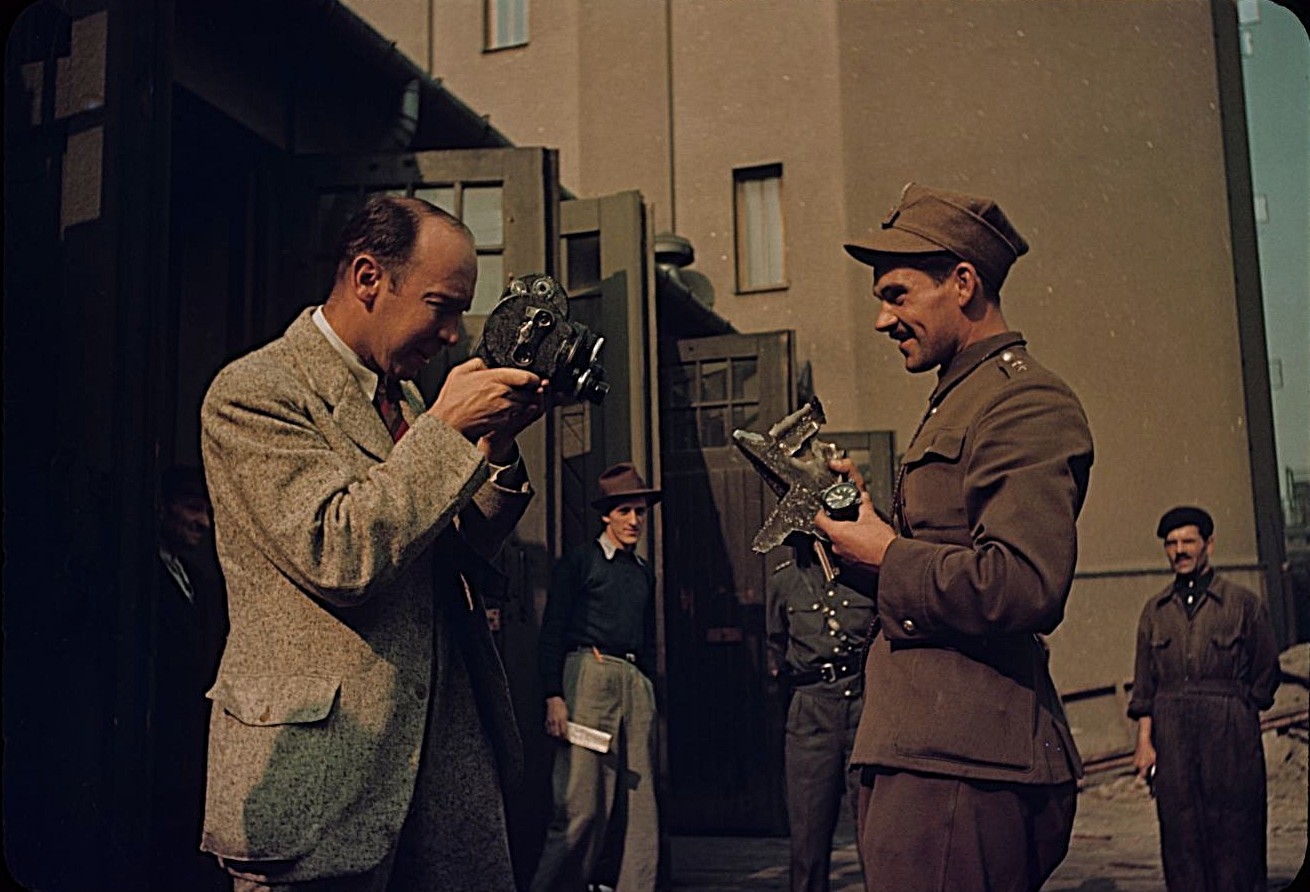
He photographed civilians queuing for bread, digging anti-aircraft trenches and anti-tank barriers, and a Polish Army soldier happily displaying a part from a downed German bomber that had crashed in Powiśle. On 10 September, shortly after the air raid in which the Hospital of the Transfiguration in Praga was damaged, he photographed hospital beds covered in rubble and glass from shattered windows.
His Leica camera captured images of newborn babies and their mothers in the basement shelter of St Sophia’s Hospital on Żelazna Street. Right next to the hospital, Bryan documented the unfinished five-storey tenement house at 78 Nowolipie Street (now 99 Żelazna Street), which had been destroyed by a 250-kilogram bomb. On the bridge, he photographed crowds of civilians during the evacuation. In Bródno, devastated by German bombs, he captured people camping out with the remnants of their belongings next to a burnt-out house.
In his photographs, we often see the youngest victims of the war – children, civilians during evacuation, and the ruins of residential buildings. Bryan captured the residents and defenders of Warsaw, their suffering, determination, courage, and at times their doubt, fear and signs of exertion. Today, some of the photographs may seem graphic, but at the time he took them to show the war without embellishment.
On 9 September 1939, in the area of Ostroroga Street, near Powązki Cemetery, Bryan took one of the most iconic photographs of the Second World War.
“Seven women were digging potatoes in a field (…) Suddenly, two German planes appeared out of nowhere and dropped two bombs on a small house about two hundred metres away. The two women inside the house were killed. The women in the field hid, hoping they wouldn’t be spotted. When the bombers had flown off, the women returned to their work (…) . But the Nazi pilots were not satisfied with their work. After a few minutes, they returned, flying some 60 metres above the ground, sweeping the field with machine-gun fire. Two of the seven women were killed and the remaining five fled. As I was photographing the bodies, a little ten-year-old girl ran up and froze beside one of the bodies. The woman was her older sister. The child had never seen death before and could not understand why her sister was not speaking to her. The child looked at us in confusion. I took her in my arms and held her tight, trying to comfort her. She was crying. I was crying too, as were the two Polish officers who were with me,” Bryan recalled in 1959.
The 12-year-old girl mourning her older sister Ania, who had been killed by Luftwaffe pilots, was Kazimiera Kostewicz. She knelt beside her sister’s body and cried out through her tears: “Tell me, tell me, what am I to do without you?”.
“I am speaking from besieged Warsaw in Poland. My name is Julien Bryan. My task is to recount in simple terms what I have seen over the past ten days. President Roosevelt! America must take action and demand an end to this most monstrous slaughter of people in modern times. We ask you, in the name of honesty, justice and Christianity, to help these brave Poles,” said Bryan on 16 September 1939 in a broadcast on Polish Radio. In his appeal to the US President, he emphasised that the invaders had failed to break the fighting spirit and that the vast majority of Polish society, both soldiers and civilians, despite enormous losses, had not given up, continuing their heroic resistance.
Thanks to Bryan’s film and his photographs, which appeared in leading American magazines such as *Life*, *Time* and *Look*, the free world learned of the unyielding resolve of civilians and Polish Army soldiers in besieged Warsaw.
On 21 September, Bryan left Warsaw with over 700 photographs and reels containing more than six hours of filmed footage, concealed as a diplomatic consignment. Some of the photographs were taken on Kodak Kodachrome colour film, which was unique at the time. On 12 February 1940, the premiere of the 10-minute documentary film Siege took place in New York. It was watched by over 40 million American viewers. The American never considered himself a war correspondent. “For two weeks in the besieged city, I photographed the struggle and agony of people affected by the madness of war,” he said as the film’s narrator.
After the war, Bryan returned to Warsaw on several occasions. At the turn of 1946/47, he travelled to Poland with a UNRRA mission, visiting Warsaw, Łódź and the Tri-City. In 1958, thanks to an appeal published in Express Wieczorny, he tracked down the subjects of his photographs from 19 years earlier: the now-adult Kazimiera Kostewicz-Mika (d. 2020), the boy sitting on the ruins – Ryszard Pajewski, Zygmunt Aksienow – the boy with the canary, Balbina Szymańska – the mother of newborns born in the cellars of St Sophia’s Hospital, and other people he had captured in his photographs.
Julian Bryan last visited the capital in August 1974. He was accompanied by his son, Sam Bryan. On 20 October 1974, the photojournalist died in Bronxville, New York. The man who left future generations a harrowing account of the tragic days of September 1939 still has no street named after him in Warsaw. The only memorial is a plaque unveiled in September 2021 on the building of the Military Police Headquarters on Ostroroga Street in Warsaw.
For those eager to learn:
Bryan J. *Warsaw 1939: The Siege*, 1959 *Warsaw Revisited: Perception and Change in the Modern City*, Warsaw, 1960
The Siege of Warsaw in the Photographs of Julien Bryan, J. Z. Sawicki, T. Stempowski, Warsaw, 2010
B.T. Stefan Radliński (in:) Memories of Stefan Starzyński, Warsaw, 1982


