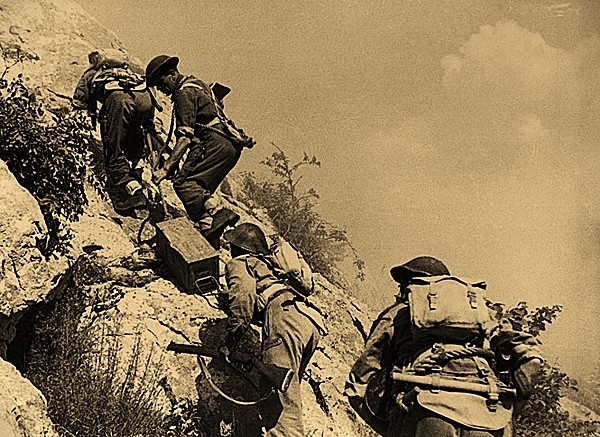
“The pass to Rome at Monte Cassino has, since time immemorial, been the place where the defenders of Italy stood in the way of invaders advancing from the south. At this point, the mountains, stretching from sea to sea, leave only a ten-kilometre-wide strip through which the River Liri flows. Battles to force this pass have been fought for centuries,” wrote Melchior Wańkowicz in “Sketches from Monte Cassino”.
The Monte Cassino massif (520 m above sea level), with its Benedictine abbey at the summit, was a key point in the German system of fortifications in the mountainous terrain of the so-called Gustav Line, which blocked the Allied forces advancing on Rome. From January 1944, Monte Cassino was the scene of bloody fighting that lasted for many months.
The initial attacks by British and American forces did not result in a decisive victory. In mid-February, Indians, Gurkhas and New Zealanders launched an assault on the hill defended by the elite German 1st Parachute Division – also to no avail. On 15 March, the Germans, entrenched on the hill, kept the surrounding valleys under fire and repelled a third assault.
The commander of the British 8th Army, General Oliver Leese, proposed to the commander of the 2nd Polish Corps, General Władysław Anders, that they take part in the fourth, decisive assault on Monte Cassino and the German defensive positions in the area. “The 2nd Polish Corps was assigned the most difficult task of capturing, in the first phase, the hills of Monte Cassino and then Piedimonte,” wrote General Anders in his memoirs, *Bez ostatniego rozdziału* (Without the Final Chapter).
The following units were deployed to the front: the 3rd Carpathian Rifle Division under Brigadier General Bronisław Duch, the 5th Kresy Infantry Division commanded by Brigadier General Nikodem Sulik, tank crews from the 2nd Independent Armoured Brigade under General Bronisław Rakowski, and the artillerymen of Colonel Ludwik Ząbkowski.
Most of the soldiers, hailing mainly from the Eastern Borderlands, had previously survived a stay in Soviet labour camps and prisons and had travelled from the USSR through Iran, Iraq, Palestine and Egypt to the Italian port of Taranto, where they began fighting on the Apennine Peninsula. The entire operation was also supported by sappers, signalmen, female volunteers from transport companies, doctors and medical staff.
The Fourth Battle of Monte Cassino began on 11 May 1944 at 11 p.m. with an Allied artillery barrage from over 1,000 guns, cannons and howitzers of various calibres. At 1 a.m. on 12 May, the 569th and 593rd The Germans, positioned on the hills, had numerous concealed artillery positions, mortars and machine guns, as well as a system of shelters and bunkers built into the rocky ground.
The access roads had been mined. The attack lasted until dawn and ended in failure. On 12 May 1944, in the afternoon, the Polish units withdrew to their starting positions. The next assault involving the Poles took place during the night of 16–17 May. The Poles captured, among other things, the famous Hill 593, known as Widmo Hill. At the same time, German positions were attacked by British troops and French colonial units.
The Germans began their retreat from the monastery. On 18 May 1944, the first soldiers of the 12th Podolian Uhlan Regiment occupied the ruins of the Benedictine monastery at Monte Cassino. At around 10 a.m., the lancer Józef Bruliński hoisted a white-and-red flag and a pennant sewn from a Red Cross flag and Second Lieutenant Kazimierz Gurbiel’s handkerchief.
At exactly midday, Emil Czech, a veteran of the battles of Tobruk and Gazala and a platoon commander in the 3rd Carpathian Sapper Battalion, played the St Mary’s bugle call on his cornet. The victory, however, came at a high cost. Between 12 and 18 May 1944, 923 soldiers of the 2nd Corps were killed. 2,931 were wounded. 345 were reported missing.
Historians estimate that the battles for Monte Cassino were among the bloodiest fought on the Western Front. “Years will pass and centuries will fade. Traces of days gone by will remain!... And all the poppies on Monte Cassino Will be redder, for they will grow from Polish blood!” – so went the words of the song ‘Red Poppies’, written by Feliks Konarski on the night of 17–18 May 1944 to music by another soldier of the 2nd Corps, Alfred Schütz.
For those eager to learn more:
W. Anders W., *Without the Final Chapter: Memoirs from 1939–1945*, London 1959
N. Davies, *The Trail of Hope*, Warsaw 2020
M. Wańkowicz, *Monte Cassino*, Warsaw 1984
M. Wańkowicz, The Battle of Monte Cassino, Warsaw 2009
Z. Wawer, Władysław Anders 1892–1970, Warsaw 2019
Z. Wawer, Monte Cassino. The Battles of the 2nd Polish Corps, Warsaw 2009


