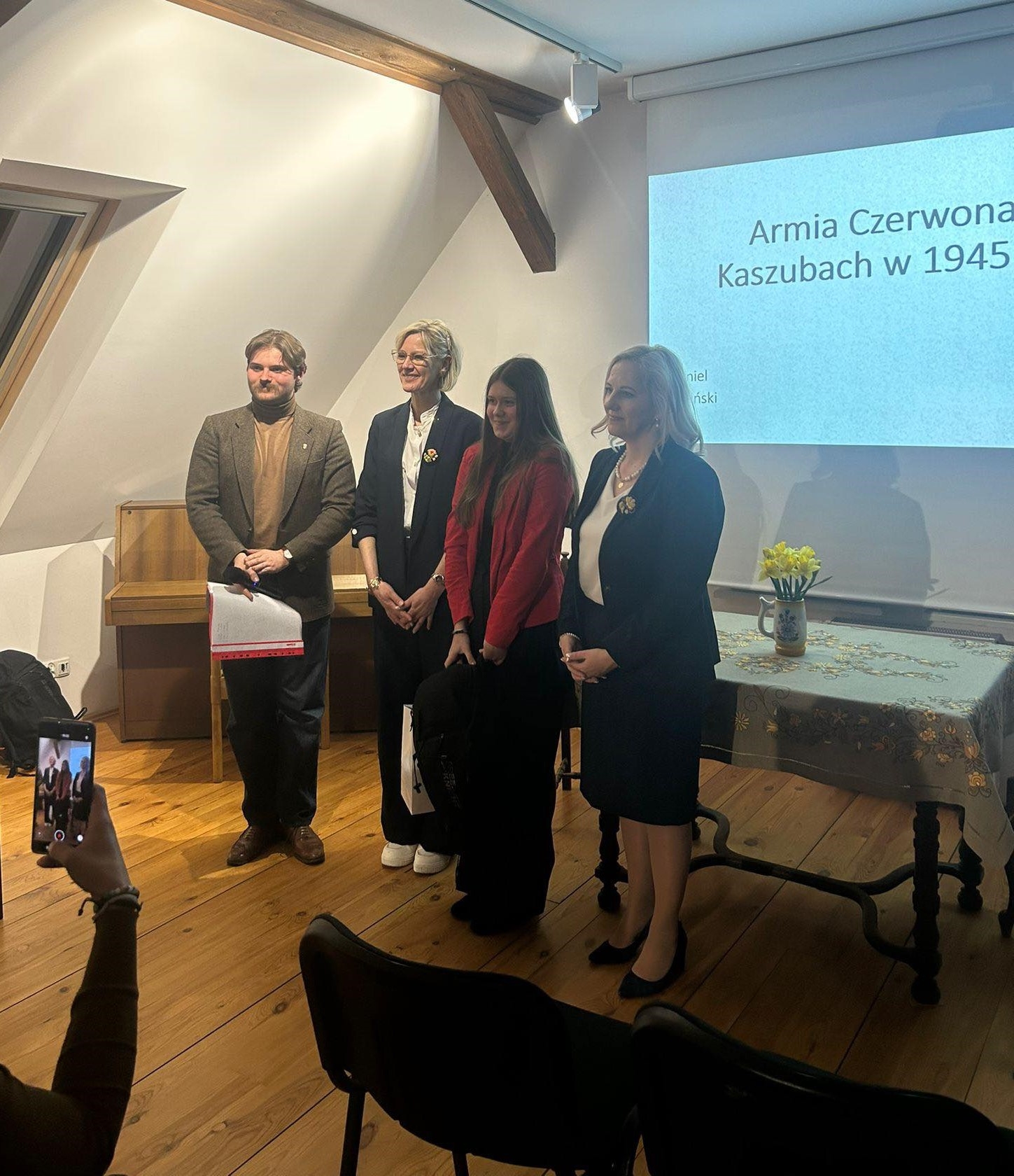
We invite you to view the photo gallery from the ceremonial conclusion of the competition ‘Dawaj Czasy! The Red Army in Poland 1945–1947 – Kashubia’, co-organised by the Jan Karski Institute of War Losses and the Franciszek Treder Kashubian Museum in Kartuzy.
The ceremony took place on 10 March at the Kashubian Museum in Kartuzy – exactly on the 81st anniversary of the Red Army's entry into the city. During the event, the results of the competition were announced and prizes were awarded to the winners, thanking the participants for their courage in tackling a difficult subject and for their willingness to preserve family memories of the dramatic events at the end of the Second World War. During the ceremony, the director of the Institute, Bartosz Gondek, laid flowers at the plaque dedicated to the victims of the Security Service and commemorating the 50th anniversary of the Kashubian Museum, paying tribute to all those whose memory it evokes.
The aim of the ‘Dawaj Czasy!’ competition was to bring to light the personal accounts of the region's inhabitants concerning the years 1945-1947. The competition was attended by both secondary school students and adult authors, who often recalled moving stories passed down through generations in their families. The works were evaluated by historians: Dr Daniel Czerwiński, Dr Damian Markowski, Dr Tomasz Luterek and representatives of the Kashubian Museum – Museum Director Barbara Kąkol and Monika Pieczora-Spychalska.
One of the most important elements of the event was a lecture by Dr Daniel Czerwiński, a representative of the research department of the Institute of War Losses, devoted to the presence of the Red Army in Kashubia in 1945. The lecture provided historical context for the Soviet invasion and was based on both archival documents and personal accounts from witnesses.
The competition entries submitted showed the drama of everyday life for the region's inhabitants at that time. One of the authors recalled attempts to escape the violence of Soviet soldiers:
‘Her youth and beauty became a threat, and her only hope of saving her life was to pretend to be old and sick. She dressed in old, dirty clothes, smeared her face with ash, and everyone was to call her “grandmother”.’
– excerpt from a competition entry inspired by memories of family history
Another competition participant recalled a shocking account by a witness to the events in Kartuzy:
‘My grandfather found Chrzanowska, a young girl, by a rubbish bin – abused by soldiers and blue with cold. She lived with us in a small room in the attic, where we blocked the door with chairs at night because soldiers came looking for “girls”.’
– excerpt from a competition entry based on the account of Henryk Seydlitz
The conclusion of the competition became an important moment for reflection on the history of the region and the significance of family memory as a source of knowledge about the past. The ceremony was not only an opportunity to honour the authors of the best works, but also to talk together about the experiences of the inhabitants of Kashubia at the turn of 1945.
The meeting at the Kashubian Museum turned out to be a moving history lesson – a reminder that many dramatic events remained in the shadows for decades, and today, thanks to testimonies and research, they can be restored to collective memory.


