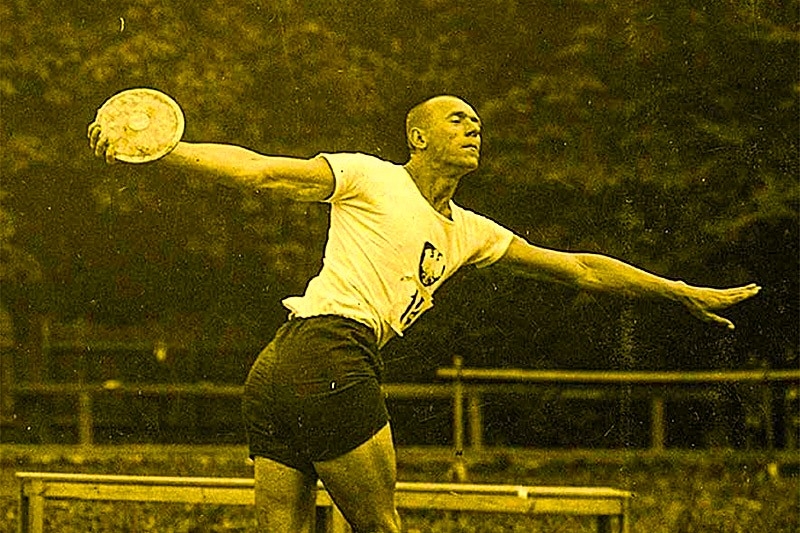
On 4 March 1899, he was born in Racławówka near Rzeszów as Józef Tomasz Baran (from March 1938 he bore the surname Bilewski) as one of six siblings. He participated in the defence of Lviv and the Polish-Bolshevik War. He completed an artillery warrant officer course. In 1921, he began athletics training at Pogoń in Lviv.
He became the manager of the Physical Education Centre at the Headquarters of the 4th Corps District. In 1922, 1923 and 1926, he became the Polish champion in shot put, breaking 13 Polish records in this discipline.
In the 1926, 1927 and 1929 seasons, he won the Polish championship title in discus throw. He won a total of 19 medals in national competitions. He represented Poland nine times in international competitions. In 1928, he also competed in the IX Summer Olympic Games in Amsterdam (discus throw), but was eliminated in the qualifying rounds. Four years later, he led the Polish athletics team at the Olympics in Los Angeles. His brother, Jan Baran, also achieved numerous successes in athletics.
From the late 1920s, he represented the Academic Sports Association in Poznań and Warsaw, and later Legia Warsaw. He became one of the most important promoters of athletics in the army and an instructor at the Central Institute of Physical Education (since 1938, the Academy of Physical Education, AWF) in Warsaw. He worked there as a lecturer and instructor. Together with Włodzimierz Humen and Czesław Mierzejewski, he co-authored the textbook Zasady nauczania lekkiej atletyki (Principles of Teaching Athletics).
After the announcement of mobilisation on 24 August 1939, one of the most outstanding athletes of the reborn Republic of Poland was mobilised as an officer of the 27th Light Artillery Regiment from Włodzimierz Wołyński. After the Soviet Union attacked Poland on 17 September 1939, he was taken prisoner by the Soviets and sent to a transit camp in Szepietówka (now Ukraine), and later to a prisoner-of-war camp in Kozelsk. His name appears on NKVD deportation list No. 029/1.
Captain Józef Bilewski was murdered around 15 April in Katyn. He is listed under number 1856 on the ‘List of names of prisoners of war missing in the USSR’ published in ‘Orzeł Biały’ on 16 October 1948. In 2007, he was posthumously promoted to the rank of major.
In Katyn, Kharkiv and other places of execution, the Soviets murdered many other Polish athletes in Polish Army uniforms. Among them were hockey player Aleksander Marek Kowalski, rower Second Lieutenant Stanisław Urban, Warta Poznań footballer and football coach Second Lieutenant Marian Spojda (Spoida), and participant in the Berlin Olympics (equestrian), cavalry captain Zdzisław Szczęsny Kawecki.


