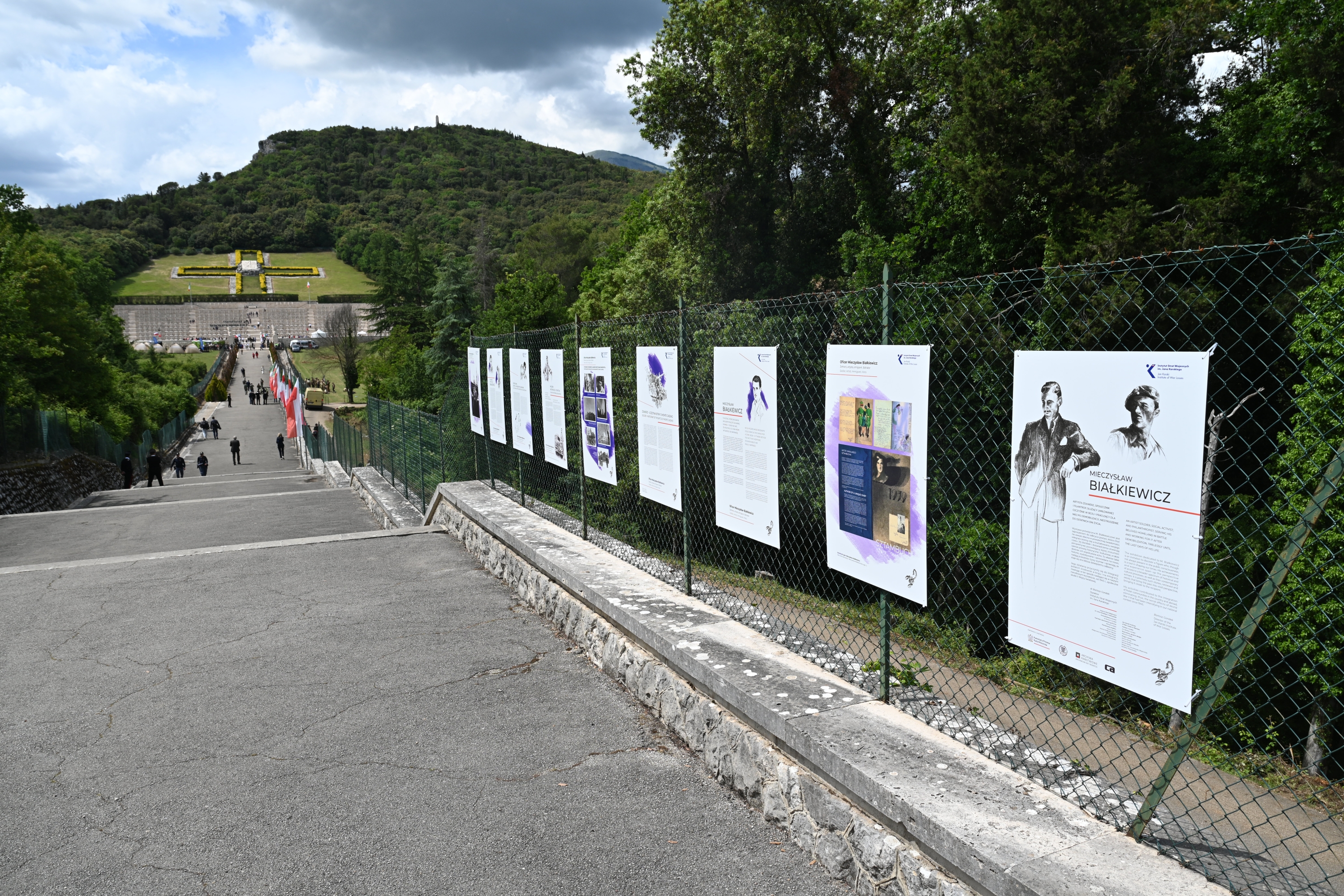
Monte Cassino is a symbolic place. It is here that the history of the Polish soldier intertwines with the memory of the sacrifice, the dispersal and the fate of an entire generation of wartime exiles. During this year’s state celebrations marking the anniversary of the Battle of Monte Cassino, the Jan Karski Institute of War Losses inaugurated an open-air exhibition dedicated to Mieczysław Białkiewicz – an officer of the 2nd Polish Corps, a war hero, an artist and the founder of an extraordinary Polish émigré community in the United Kingdom. His efforts contributed to the integration of Polish communities in exile, thereby mitigating the social consequences of the Second World War, which had been intensifying in our national context since 1945.
The exhibition is on display at the entrance to the Polish War Cemetery at Monte Cassino, opposite the Museum of the 2nd Polish Corps. It is there that Mieczysław Białkiewicz’s uniform is also kept, meaning that the exhibition naturally complements the museum’s narrative about General Anders’s soldiers and their post-war fates.
On 18 May, the exhibition was officially opened by the organiser of the anniversary celebrations – Minister Lech Parell, Head of the Office for War Veterans and Victims of Oppression – along with representatives of the Polish authorities, including Minister Jakub Stefaniak – Deputy Head of the Prime Minister’s Office, Deputy Minister of National Defence Stanisław Wziątek, Deputy Minister of Family, Labour and Social Policy Sebastian Gajewski, MP Piotr Adamowicz, and Director of the Institute of War Losses Bartosz Gondek.
Białkiewicz was a figure straight out of a film. A tank ace of the September Campaign, a soldier in the Independent Carpathian Rifle Brigade, a participant in the battles for Tobruk and an officer in the 4th Armoured Regiment ‘Skorpion’, for which he created the famous desert scorpion insignia. For his heroism at Monte Cassino, he was awarded the Silver Cross of the Order of Virtuti Militari. After the war, he remained in exile, like thousands of soldiers of the Polish Armed Forces in the West. He was one of the first to recognise the importance of immediate action to mitigate the social and identity-related losses resulting from the Second World War, both within émigré communities and amongst his compatriots who were left to rebuild Poland on the other side of the Iron Curtain.
It is precisely this aspect of his biography that became one of the main reasons for the Institute of War Losses to organise the exhibition. Białkiewicz’s story shows that Poland’s wartime losses were not only destroyed cities and lost material goods, but also a scattered elite forced to rebuild their lives outside their homeland.
The exhibition, organised by the Institute of War Losses, thus illustrates not only the extraordinary journey of one man, but also the fate of an entire generation of Polish soldiers, artists and émigrés who, despite being scattered by the war, remained ambassadors of Polish identity and historical memory. The figure of Mieczysław Białkiewicz and the concept behind the exhibition demonstrate that Poland’s wartime losses were not merely material destruction, but also the loss of people whose experiences in exile have become part of a heritage now being restored by the Institute.
The exhibition attracted considerable interest from those attending the ceremony at Monte Cassino, and following its premiere, it will embark on a further tour of Poland.


