Although more than eight decades have passed since the end of the Second World War, thanks to a steady stream of new discoveries (such as last year’s discovery of the flag of the flagship of the Pinsk Flotilla, ORP Admiral Sierpinek), we continue to receive further evidence of what remains the greatest armed conflict in human history.
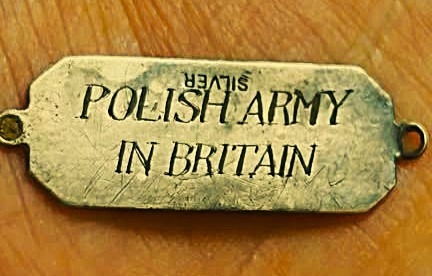
Among these is a valuable memento of the Polish Armed Forces in the West’s role in crushing the German war machine during the fighting in France in the summer of 1944. We are referring to a silver dog-tag bracelet, discovered by a young French resident using a metal detector.
The discovery was made last year in the fields of Normandy, which, for the troops under General Stanisław Maczek of the 1st Armoured Division, became the scene of battles with the Germans from 8 August 1944. During this period, the Battle of Falaise (12–21 August) proved to be particularly intense, in which the Polish unit played a special role.
The dog tag bracelet that was found was made to individual order and was not part of the standard equipment of Allied soldiers. The engraved inscriptions left no doubt as to its owner. “FR. KRĘŻAŁEK ŁĘKI – KROSNO POLISH ARMY IN BRITAIN” turned out to be Captain Franciszek Krężałek, born on 15 September 1906 in Łęki (now Łęki Dukielskie) in the Podkarpacie region, an officer in the Supply Command of the division commanded by General Maczek.
Even earlier, during the defensive war in September 1939, Franciszek Krężałek commanded a machine-gun platoon as part of the Polish Army units that formed an improvised line of defence on the south-eastern borders of the country (the so-called Romanian Outpost). However, the treacherous Soviet attack on 17 September 1939 thwarted the implementation of this plan.
Like many of his fellow soldiers and officers in the Polish Army, his subsequent journey took him through Hungary, Italy and France. Following the defeat of the latter in early summer 1940, Franciszek Krężałek was among the fortunate few who managed to reach Great Britain. He thus took part in the subsequent re-establishment of the Polish armed forces.
As a Supply Officer in the Divisional Supply Company, he was highly regarded by his superiors. It is therefore not surprising that, even before the fighting in Normandy, he was entrusted with a crucial role in the Supply Command of the 1st Armoured Division. There, he served as the supply officer for fuel and other operating fluids, essential for the proper functioning of the unit. Planning, record-keeping and the distribution of fuels, lubricants and oils were among his primary duties.
As time went on, he proved himself more than capable of fulfilling his duties. A particularly critical phase of the operations carried out by the units under his command was the pursuit of German forces being driven out of France by the Allies. This resulted in a sharp increase in the length of supply routes and a simultaneous rise in fuel consumption. Captain Krężałek and his subordinates demonstrated immense dedication and efficiency at that time, contributing significantly to the continued rapid advance of the leading units of the 1st Armoured Division. General Stanisław Maczek himself spoke highly of their work.
The officer in question also played a part in the memorable capture of Breda (28–30 October 1944) and the no less famous seizure of the German Navy base at Wilhelmshaven (5 May 1945). After the war ended, he decided to return to his homeland. Like many other veterans of the Polish Armed Forces in the West, he too was subjected to surveillance by the communist secret police in the years that followed. He died in April 1965.
Towards the end of last year, there was a lot of buzz on social media about the dog-tag bracelet he had mentioned. The captain’s son, Mr Marek Krężałek, then got in touch with the French man who had found the artefact. As it turned out, Mr Hektor (for that is the finder’s name) immediately declared his willingness to hand over the find to Mr Marek. To this end, he will travel to Krosno in person in August, and the handover of the dog tag bracelet will take place at the local Private Museum of the Podkarpacie Battlefields.
Information regarding the valuable find comes from the social media profile of the aforementioned institution. Information about Captain Franciszek Krężałek, meanwhile, was taken from a text compiled by Mr Lesław Wilk.
The text is supplemented by photographs from, among others, the collections of Marek Krężałek and the Private Museum of the Podkarpacie Battlefields.


