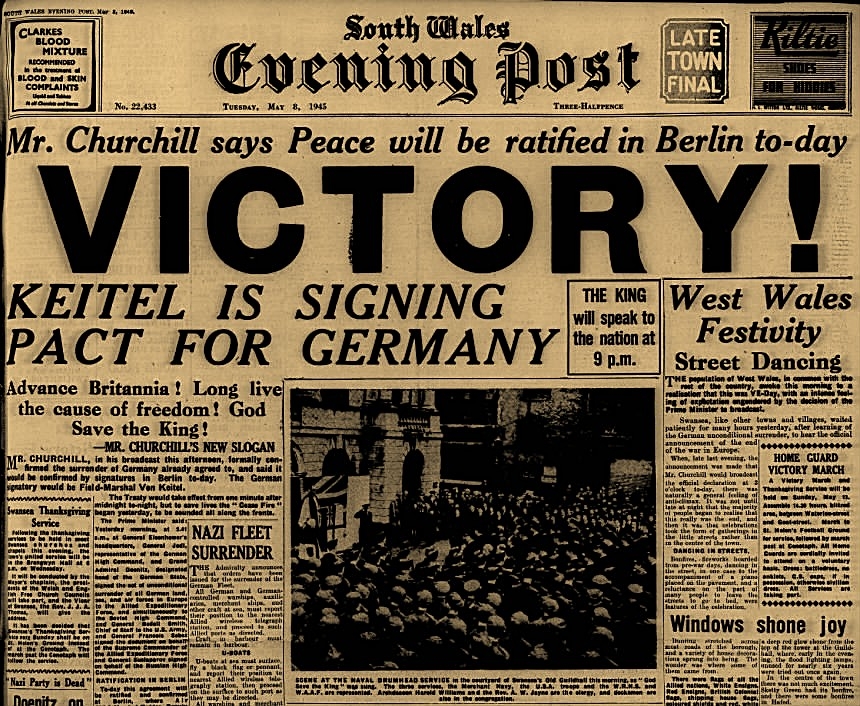
8 May is celebrated as Victory in Europe Day, marking the Allied victory over the Third Reich and the anniversary of the end of the Second World War in Europe. Representatives of the Third Reich’s armed forces signed the surrender at General Dwight Eisenhower’s Supreme Headquarters Allied Expeditionary Force (SHAEF) in Reims (France) on 7 May 1945 at 02.41.
At Stalin’s request, the signing of the surrender document was repeated the following day at Marshal Georgy Zhukov’s headquarters in Berlin-Karlshorst. According to the Moscow Standard Time (MST) zone, it was already past midnight: to this day, Russia and the post-Soviet states celebrate the anniversary of the end of the war on 9 May.
Was 8 May 1945 actually Victory Day in Poland? As a result of the war, Poland, which was the first country in Europe to offer armed resistance to Hitler’s army, lost around 5.2 million citizens, including approximately 2.8 million Poles of Jewish origin. For every 1,000 inhabitants of the Republic of Poland, 220 people did not survive the war. Nearly 590,000 people were left disabled. Poland lost its intellectual elite, including 55% of doctors, 40% of lawyers and 20% of university lecturers.
Over 2 million Polish citizens worked in the Reich as forced labourers. A separate issue is the tragic fate of millions of Poles who, after 17 September 1939, found themselves under Soviet occupation. Around 300,000 Polish citizens remained in Siberia and other parts of the USSR. Thousands more were held in prisons and camps.
As a result of the war, Poland lost 46.3% of its territory to the ‘liberators’ – who were, in fact, new occupiers: the Soviet Union. The shift of the borders to the west did not compensate for the loss of the eastern provinces of the Republic of Poland. Material losses amounted to an average of 38% of the pre-September 1939 level. 162,000 buildings and around 14,000 industrial plants were destroyed or looted. Poland lost around 43% of its cultural heritage.
From the first to the last day of the greatest conflict in human history, the Poles were part of the anti-Hitler coalition fighting on all fronts and constituted the fourth-largest Allied army. The bitter epilogue to the Second World War was the London Victory Parade on 8 June 1946. On that day, the British refused to allow soldiers of the Polish Armed Forces in the West to take part in the event. It took just over a year for the Allies to ‘forget’ the Polish soldiers’ participation in the battles for Tobruk, Monte Cassino, Bologna, Falaise, Breda and Arnhem…
“The end of the war with Germany found Poland in an extremely difficult, even tragic, situation. ‘Whilst other nations, particularly those in the West, regained genuine freedom following the end of the German occupation and were able to set about organising their own lives independently, Poland, having suffered the greatest losses in the war, found itself under occupation with a government imposed by a neighbouring state’ – reads the proclamation of the underground parliament – the Council of National Unity – to the Polish Nation and to the United Nations dated 1 July 1945. It would be hard to find a more apt answer to the question of whether 8 May was, in post-Yalta Poland, a true Victory Day?
For those eager to learn:
T. Bereza, P. Chmielowiec, P. Fornal, 8 May 1945: The Polish Perspective, Rzeszów–Warsaw 2023
G. Dallas, A Poisoned Peace: 1945 – The War That Never Ended, Wrocław 2012
A. Beevor, Berlin: The Downfall 1945, Kraków 2009


