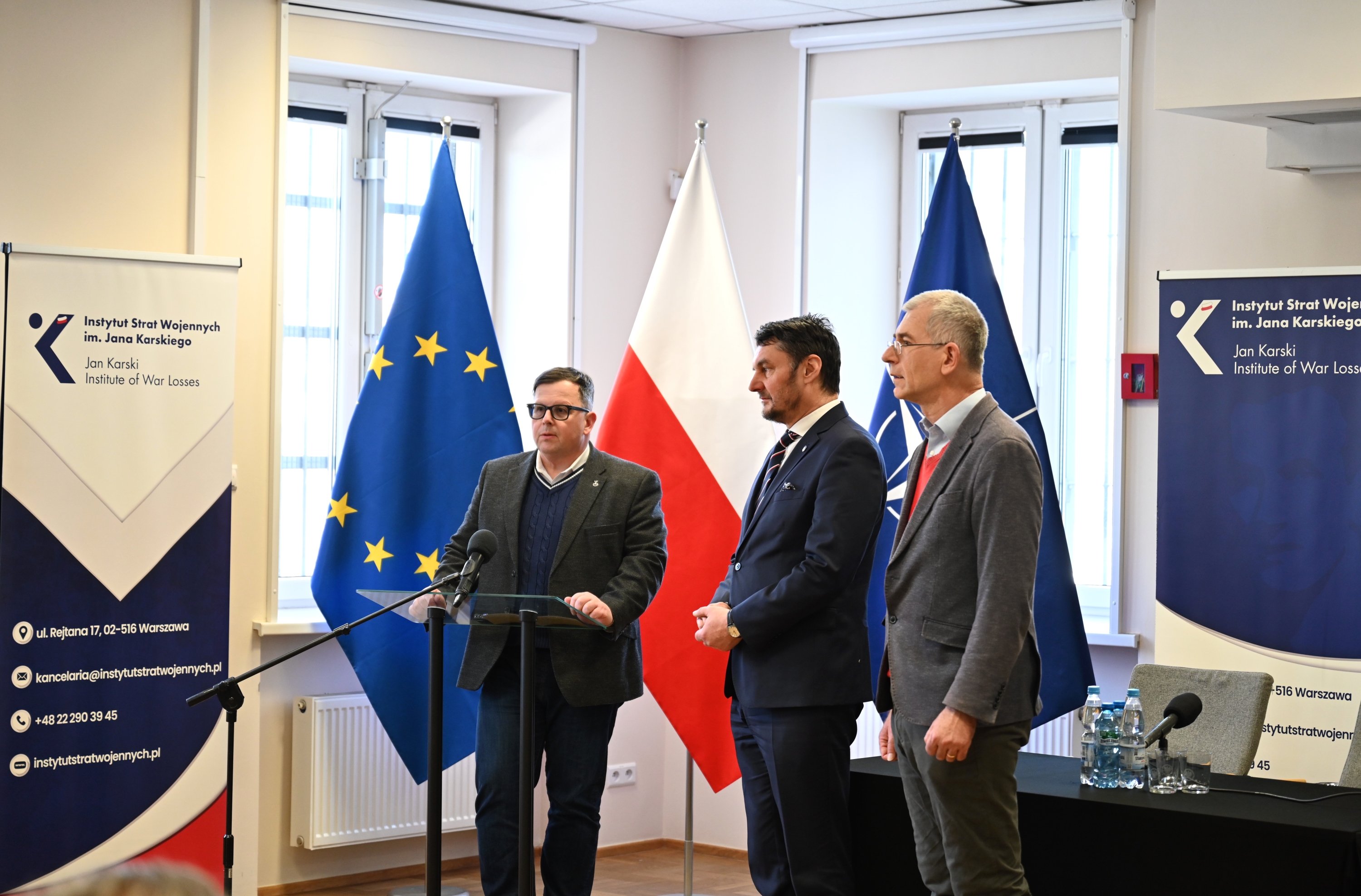
On Monday, 16 February, a ceremony commemorating the National Day of Remembrance of Home Army Soldiers was held at the headquarters of the Military Historical Office in Warsaw, co-organised by the Jan Karski Institute of War Losses, the Military Historical Office and the Office for War Veterans and Victims of Oppression. The event paid tribute to the soldiers of the Home Army, the largest underground army in occupied Europe, who fought an unequal battle for the independence of the Republic of Poland and the preservation of its identity during World War II.
The ceremony was attended by Minister Lech Parell, Head of the Office for War Veterans and Victims of Oppression, Dr Bartosz Gondek, Director of the Jan Karski Institute of War Losses, and Prof. Grzegorz Motyka, Director of the Military Historical Office. The presence of representatives of state institutions and academic circles emphasised the importance of historical memory as the foundation of the contemporary national community.
A special moment of the ceremony was the transfer of the legacy of Marian Kleban, a Home Army soldier, saved from destruction, to the Central Military Archives. The documents, including an officer's commission and an extensive collection of personal files, were found and secured by the Pruszcz Historical and Research Association ‘Faktoria’. The rescued materials are an invaluable research source for historians studying the history of the Polish Underground State and the fate of Polish patriots during a dramatic period.
Adam Brzozowski and Arkadiusz Musijowski, representatives of the Faktoria Association, described the circumstances surrounding the discovery of the documents and the stages of the search that made it possible to reconstruct Marian Klebana's post-war fate in Pomerania. This story was supplemented by a presentation of the results of archival research conducted by researchers from the Military Historical Office. The collected materials showed the fate of the Home Army officer not only as a soldier in the underground, but also as a man who, after the end of the war, had to face repression and the difficult reality of Poland under communist rule.
Marian Klebana's story is part of the broader, often dramatic fate of Home Army soldiers. After years of fighting the German occupiers, and often also confronting the Soviet apparatus of violence, many of them experienced arrests, show trials, imprisonment or social exclusion. Some were sentenced to death, others lived for decades in the shadow of repression, deprived of the opportunity to participate fully in public life. Despite this, they remained faithful to their oath, the essence of which was to serve their homeland.
After the official part, a panel discussion was held, led by Prof. Damian Markowski, head of the Institute's research department, and Prof. Grzegorz Motyka, Director of the Military Historical Office, devoted to the role and significance of the Home Army in the fight against German and Soviet oppression. The participants emphasised that the Home Army was not only a military structure, but also a pillar of the Polish Underground State – an underground organisation unprecedented on a global scale, which maintained the continuity of statehood and national spirit under brutal occupation. The examples of heroic struggle on Polish soil and the personal testimonies of underground soldiers highlighted the scale of sacrifice and determination in defending Polishness.
Bartosz Gondek, Director of the Institute of War Losses, emphasises that caring for the preservation and dissemination of historical testimonies, such as the legacy of Marian Klebana, is not only a duty to past generations, but also an investment in the historical awareness of future ones. The memory of the Home Army soldiers remains a permanent element of national identity and a reminder that freedom is not given once and for all, but requires courage, solidarity and fidelity to values.


