
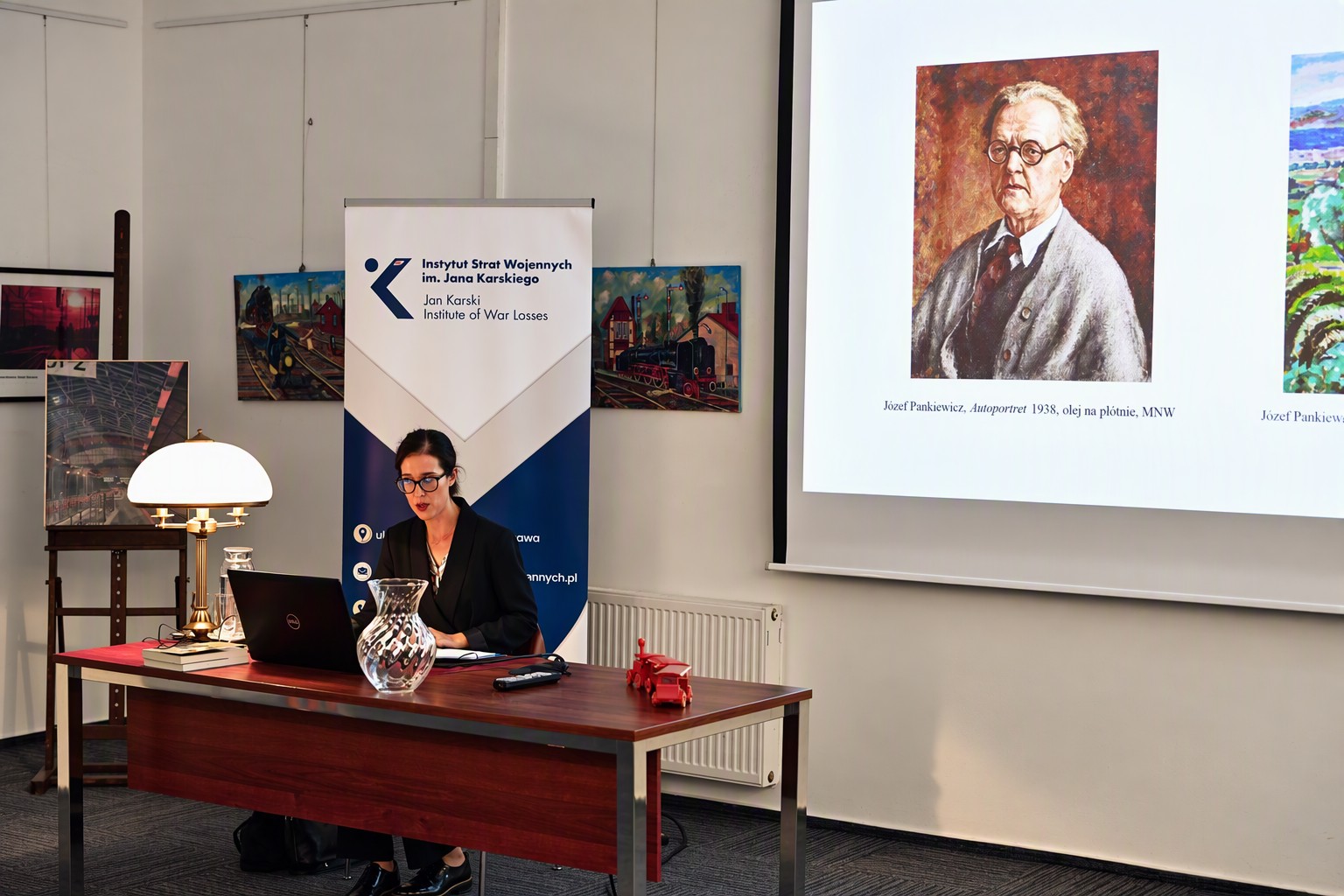
On October 6, 2026, at the Jan Nowak-Jeziorański Information Center in the Śródmieście District of Warsaw, Dr. Katarzyna Anna Kesling, associated with the Institute of Art of the Polish Academy of Sciences, delivered a lecture entitled “Jan Rubczak and Other Polish Painters – Victims of World War II.”
During the years 1939-45, many Polish painters lost their lives as a result of warfare or the repressive actions of the Nazi and Soviet occupiers. Dr. Kesling’s lecture introduced the audience to forgotten artists, their achievements, and the tragic fate of Jan Rubczak and other painters who were victims of the war.
On May 27, 1942, at the Auschwitz concentration camp, mass murderer SS-Hauptscharführer Gerhard Palitzsch shot and killed the painter Jan Rubczak and 24 other artists arrested during a raid at the Krakow House of the Association of Visual Artists. The speaker explained that the victims included painters Kazimierz Chmurski, Tadeusz Mróz-Łękawski, Józef Jakiełek, Tadeusz Palczewski, Tadeusz Różycki, Borys Petryński, and Karol Siwek.
A month later, in occupied Warsaw, one of the most outstanding painters of the Second Polish Republic and the first rector of the Warsaw Academy of Fine Arts, Prof. Tadeusz Pruszkowski made a dramatic escape attempt while being transported to Pawiak prison and was shot by a Gestapo officer.
Roman Kramsztyk gained great popularity in Warsaw and Paris, where he lived. He exhibited his work in Barcelona, Brussels, and New York, among other places. The outbreak of the war found him in Warsaw. He was sent to the ghetto and died there in August 1942 during the great deportation operation.
What did the main participants of the lecture have in common? They all graduated from Paris and belonged to the creative elite of the independent Polish Republic. They fell victim to the coordinated actions of the occupiers, who sought the complete physical elimination of the Polish intellectual elite. Rubczak and Pruszkowski were not only painters but also academic lecturers, role models for subsequent generations of art students. Their deaths were therefore a double loss for Polish culture and science.
Dr. Kesling, describing the painters who were victims of Nazism, emphasized that many Polish artists were also victims of the criminal Soviet communist system. The fates of artists who were victims of Soviet crimes are still little known and were completely ignored for years. Knowledge about Polish painters who were victims of both totalitarian regimes is incomplete and requires further research.
The lecture, “Jan Rubczak and Other Polish Painters: Victims of War,” was presented as part of the “Shadows of War: Conversations on Losses and Memory” series at the Jan Karski Institute of War Losses in Warsaw.
Sincere thanks to the Management of the Public Library in the Śródmieście District of Warsaw, and the Jan Nowak-Jeziorański Information Center, for the opportunity to present the lecture.