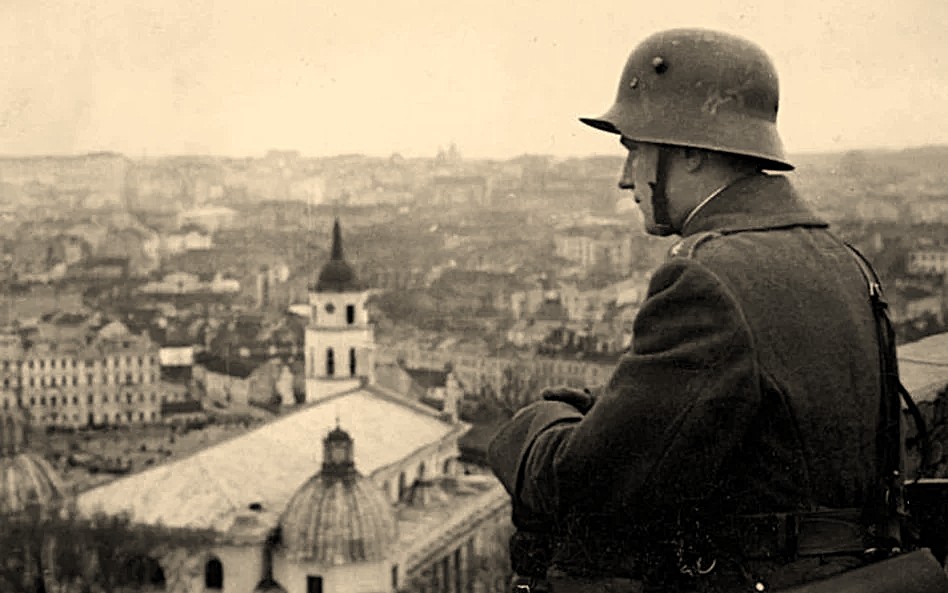
On September 19, 1939, Soviet troops participating in the invasion of Poland, after fighting Polish Army units commanded by Colonel Jarosław Okulicz-Kozaryn, occupied Vilnius, a provincial capital with a population of approximately 209,000.
It is worth recalling that on the second day of the war, the Lithuanian authorities, led by the President of the Republic of Lithuania, Antanas Smetona, declared neutrality and provided shelter to several thousand Polish soldiers and civilians. At the same time, some Lithuanian politicians advocated for the capture of Vilnius.
Between October 3rd and 10th, the Lithuanian side negotiated with the Soviets the terms of annexing Vilnius to Lithuania in exchange for the location of military bases and airports in its territory. The Lithuanian side accepted the terms set by the Soviets.
Under the “Treaty on Mutual Assistance and the Transfer of Vilnius and the Vilnius Region to Lithuania,” signed on October 10, the Lithuanian side received, in addition to Vilnius, parts of the former Vilnius-Trakai, Švenčionys, Grodno, Lida, Ošmiana, and Braslav counties.
The situation from the summer of 1920 was repeated, when Bolshevik Soviet Russia handed Vilnius over to the Lithuanians. The Soviets established military bases in Gajżuny, Novaya Vilnia, Alytus, and Preny, among other places. On October 28, 1939, Lithuanian army units entered Vilnius.
For the next several months, the Lithuanian authorities pursued a hostile policy towards the Polish community, including restrictions on the activities of Polish schools, scouts, unions, and associations. On December 15, In 1939, Stefan Batory University in Vilnius was closed. Most of Vilnius’s streets and squares were renamed from Polish to Lithuanian.
Vilnius was supposed to take over the role of Lithuanian capital from Kaunas. The first Polish underground organizations were formed. Protests and demonstrations against the government’s repressive policies and widespread Lithuanization began.
On June 15, 1940, the Soviet occupation of Lithuania began. President Smetona emigrated to Germany and then to the United States, where he died in January 1944. Lithuania lost its independence and for half a century was a republic of the USSR.
For those eager for knowledge:
C. Grzelak, Vilnius 1939, Warsaw 1993
A. Srebrakowski, Poles in the Lithuanian SSR, Toruń 2002
L. Tomaszewski, The Vilnius Region in the Years of War and Occupation 1939-1945, Warsaw 1999