
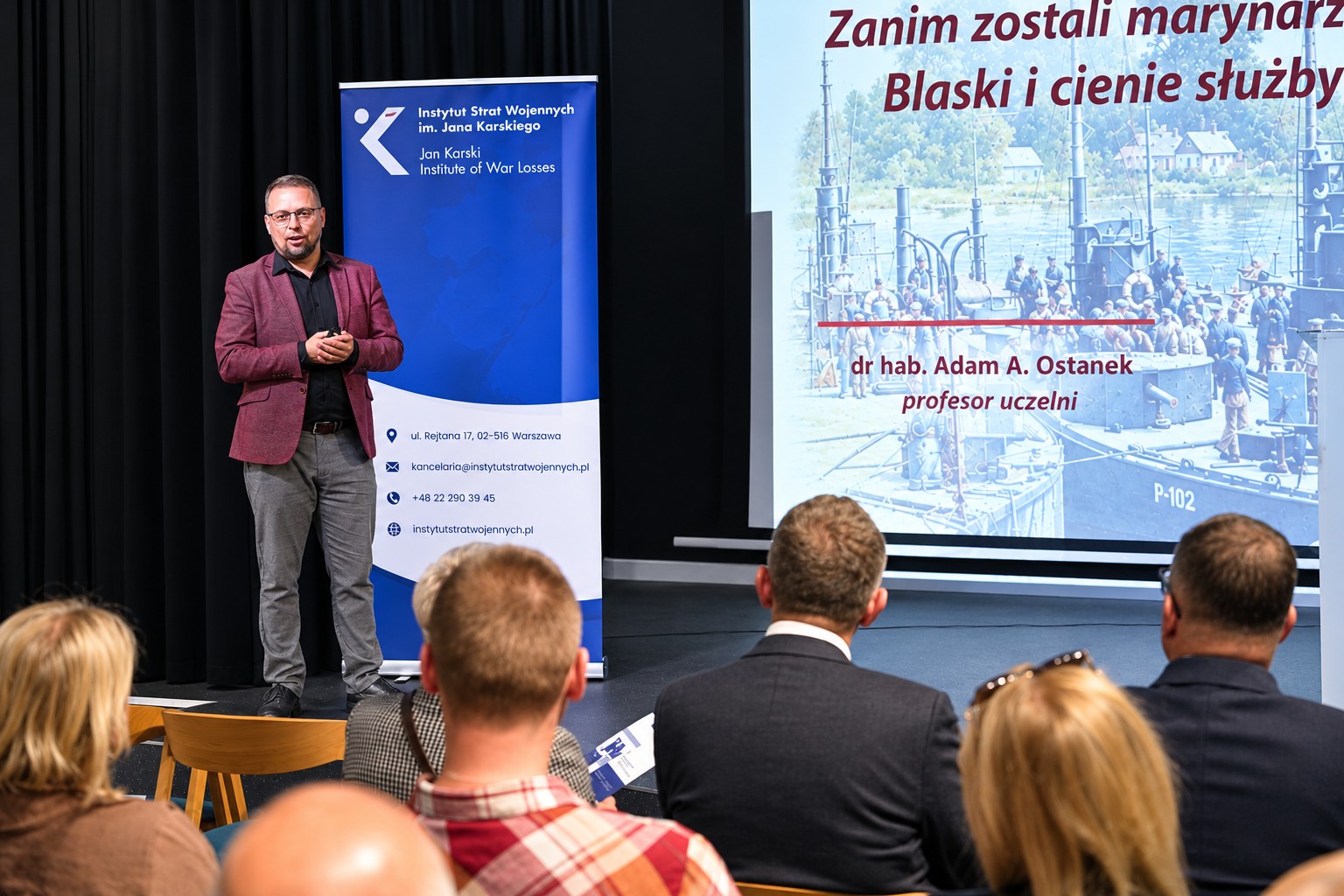
On October 4th, a lecture by historian Dr. Adam Ostanek, lecturer at the Military University of Technology in Warsaw and the Police Academy in Szczytno, “Before They Became General Kleeberg’s Sailors. The Pros and Cons of Service in the Pinsk Flotilla,” took place at the Kleeberg Combat Action Museum in Wola Gułowska.
During the lecture, Dr. Adam Ostanek, lecturer at the Military University of Technology in Warsaw and the Police Academy in Szczytno, delivered a lecture entitled “Before They Became General Kleeberg’s Sailors. The Pros and Cons of Service in the Pinsk Flotilla.” Adam Ostanek explained the circumstances in which dismounted sailors from the Navy’s Riverine Flotilla in Pinsk found themselves in General Franciszek Kleeberg’s ranks, fighting in the Kock area as early as early October 1939.
The historian recalled that during the Second Polish Republic, no one was surprised to see sailors marching through the streets of Pinsk, located several hundred kilometers from Gdynia. During the interwar period, the flotilla, as part of the Navy, was stationed in Pinsk on the so-called Pinsk Sea, in the basin of the Pina and Pripyat rivers, securing the eastern border of the Republic of Poland against Soviet attack.
The area was called the Pinsk Sea due to the size of the water area around the Pripyat River. He emphasized that on September 20, 1939, after the sinking of the vessels, some of the flotilla’s sailors ended up as soldiers of, among others, the naval battalion of the 60th Infantry Division of the Polish Army and other units of General Franciszek Kleeberg, which were transformed into the Independent Operational Group “Polesie.” They had traveled hundreds of kilometers from the Pinsk area, participated in numerous battles with the Soviets and Germans, and reached the Lublin region, near Kock. The lecture concluded by emphasizing that during the 1939 defensive war, naval battalions fought in only two locations: Oksywie and the Battle of Kock. In the context of the lecture’s topic, it is significant that a representative of the 3rd Battle Fleet named after Commander Bolesław Romanowski was also among the audience.
The director of the Institute of War Losses named after At the Jan Karski Institute of Military History in Warsaw, Dr. Bartosz Gondek recalled that years ago he spoke with a former sailor from the Polish Navy’s Riverine Flotilla in Pinsk, who lived in Gdynia and who, in 1939, hid the flag of the headquarters ship ORP Admirał Sierpinek under his horse’s saddle, preserved it, and preserved it for posterity.
The lecture was held as part of the “Shadows of War. Conversations on Losses and Memory” series at the Jan Karski Institute of Military History in Warsaw.
We would like to thank Iwona Adamska, Director of the Kleeberczyk Museum of Combat Action in Wola Gułowska, for the opportunity to present the lecture, and Monika Zaręba, the museum’s exhibition guide, for her organizational and substantive support.