
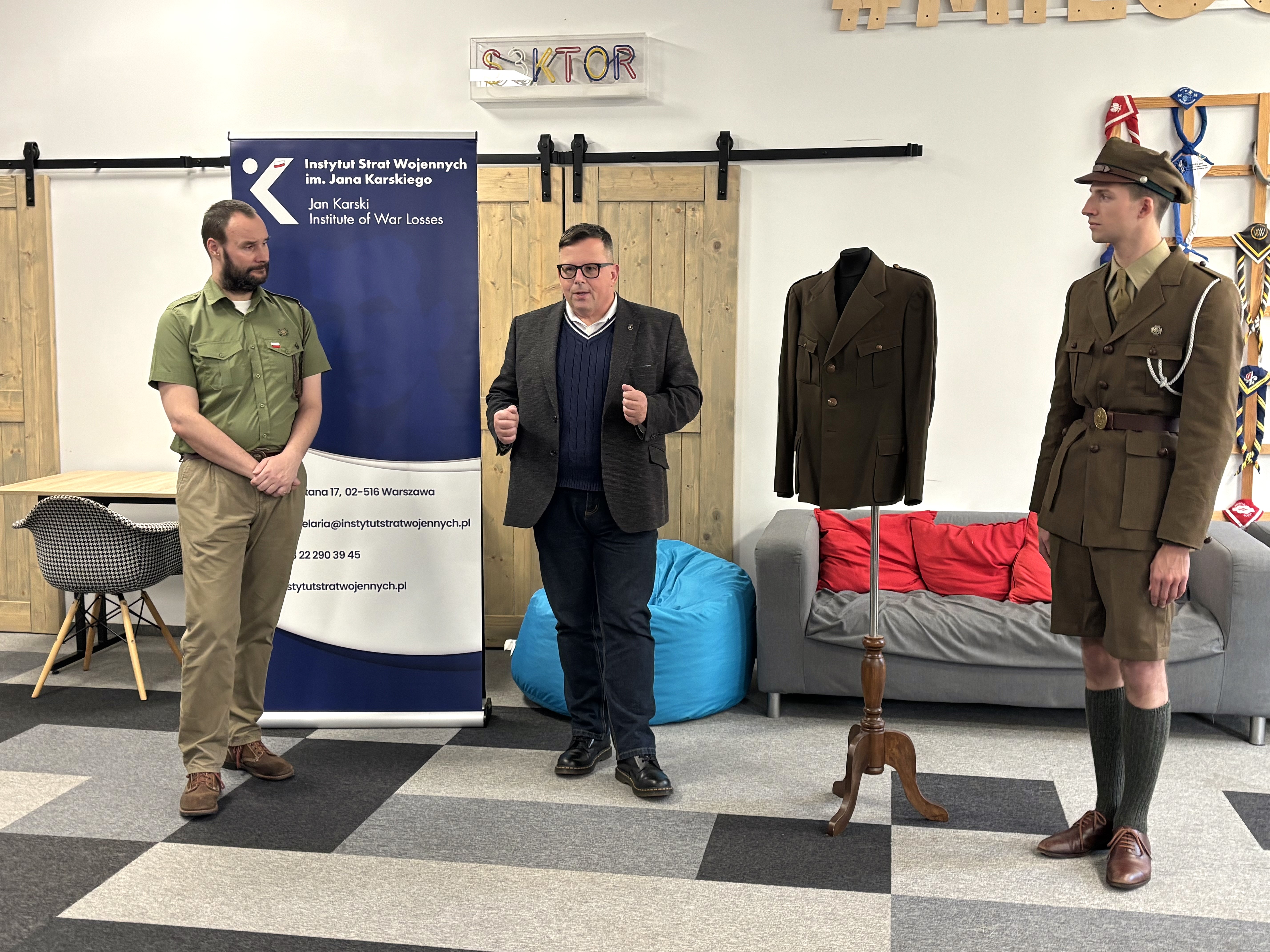
A unique relic and the only known reconstruction of a historical pattern. An original Scout instructor’s jacket from the 1930s, preserved in the collections of the Scouting Museum, and an exceptionally faithful reconstruction of a pre-war uniform were presented side by side during a special press conference in Warsaw. This unique event allowed historians, reenactors, and the entire Scouting community to see up close a remarkable testimony to the history of Polish Scouting. The reconstruction will be publicly presented for the first time on November 11th during the Independence Day Parade in Gdańsk.
The Scouting Museum in Warsaw played a key role in this unique undertaking, as its collection includes an exceptionally rare original instructor’s coat from the Second Polish Republic. This unique discovery is all the more historically significant because museum workers were able to identify its owner – Wojciech Niederliński, a pre-war Scoutmaster and later Commander of the Silesian Grey Ranks Banner. Thanks to the Museum’s involvement and the availability of this priceless artifact, its first public presentation alongside a contemporary reconstruction has become possible.
Its creator is Jakub Dudzik, a young ZHP instructor from Elbląg, who meticulously recreated a nearly forgotten pattern of pre-war uniforms. The conference, during which both items were publicly presented for the first time, was jointly organized by the Institute of War Losses. Jan Karski and the Office for War Veterans and Victims of Oppression. The event was more than just a presentation of historical uniforms – it also served as a tribute to the generation of scouts and instructors whose lives and activities were dramatically interrupted by World War II.
Before the war, the Scout uniform was much more than just an organizational uniform. It served as a symbol of community belonging, equality, responsibility, and readiness to serve. It united young people from diverse social backgrounds, reminding them that the Scout Promise was binding regardless of background or financial status. Of particular significance was the instructor uniform, worn by those responsible for educating subsequent generations of Scouts and leading troops, scouts, and higher organizational structures. An elegant jacket with a tie, paired with distinctive shorts and leggings, distinguished instructors, emphasizing their role and authority.
The uniform pattern presented at the conference was introduced in the mid-1930s. It was a testament to both Scouting tradition and the aesthetics and culture of social life in the Second Polish Republic. Wojciech Niederliński (1908–1999), to whom the preserved Frenchman belonged, was one of the leading Scout activists in Upper Silesia. During the interwar period, he held responsible positions within the Polish Scouting Association (ZHP), including the Silesian Scout Banner Command, and trained instructors. During World War II, he was active in the underground resistance movement, commanding the Silesian Grey Ranks Banner from 1942 to 1945. After the war, he became involved in the rebuilding of Scouting in Silesia.
In addition to the Frenchman’s coat, original uniform elements – a cap and belt – also survived. Currently on loan to another museum, the Frenchman’s coat alone was presented during the conference, juxtaposed with the uniform recreated by Jakub Dudzik. Although the complete original set has not survived, the existing elements constitute an extremely valuable testimony to the pre-war Scouting tradition.
Especially significant, Niederliński was appointed commander of the clandestine unit in 1942 by Scoutmaster Florian Marciniak, the first commander of the Grey Ranks. Marciniak was arrested by the Gestapo in 1943 and murdered in February 1944 in the German Gross-Rosen concentration camp. This historical connection further underscores the significance of the preserved Frenchman’s coat, belonging to a man who participated in both the building of the pre-war Scouting movement and its wartime clandestine activities.
The contemporary reconstruction was created by Jakub Dudzik from Elbląg – a Polish Scouting and Guiding Instructor, an Eagle Scout, and a history and historical reenactment enthusiast. He has been involved with the ZHP Elbląg Troop for years, engaging in youth education and organizational activities. He has been involved in historical reenactment since 2022, and in 2025, he founded the Scout Historical and Reenactment Club, which he leads to this day.
Dudzik undertook the incredibly demanding task of recreating the uniform, complete original examples of which are now extremely rare. The goal was not simply to sew a garment resembling the pre-war uniform, but to faithfully recreate its construction, proportions, materials, and the smallest details. The reconstruction was based on the most comprehensive collection of currently available archival sources, including historical uniform regulations, documents, engravings, and period photographs. Brown wool suit fabric and distinctive braided leather buttons were used to create the replica. Tailors, a shoemaker, a leatherworker, a hatmaker, and an engraver worked on the individual elements, while Jakub Dudzik was responsible for the historical development of the project and the selection of solutions consistent with extant sources.
The result of this work, especially the precision of the detail, won the praise of historical reenactment experts. To the best of our knowledge, this is the only known reconstruction of an instructor uniform of this particular design, executed with such meticulous attention to historical accuracy, materials, and detail.
The project also had a special symbolic significance. Using his own knowledge, passion, and skills, this young contemporary instructor restored the material evidence of the traditions of his pre-war predecessors. People who educated young people to serve Poland, and a few years later, they themselves had to face the dramatic challenges of war.
The history of this generation of Scout instructors is inextricably linked to the tragic events of World War II. One of its symbolic figures was the aforementioned Florian Marciniak. Another was Scoutmaster Alf Liczmański, the organizer and commander of the Polish Scout movement in the Free City of Gdańsk. Arrested by the Germans in 1939, he was imprisoned in the Stutthof concentration camp, and murdered in Graniczna Wieś on March 20, 1940.
Before the war, such instructors organized camps, led troops, taught independence, responsibility, and cooperation. They educated young citizens who would later develop an independent state. In September 1939, this world ceased to exist in its previous form. Many instructors and their students became active in the underground. Others were imprisoned and imprisoned in concentration camps, executed, and killed during wartime operations and the Warsaw Uprising.
At the end of the Second Polish Republic, the Polish Scouting and Guiding Association had over 200,000 members and was one of the largest educational organizations in the country. The outbreak of war interrupted the activities of thousands of troops and dramatically changed the fate of their members. Boy and Girl Scouts participated in the defense of Poland, underground activities, medical, communications, and welfare services, sabotage, and armed combat.
According to the findings of historian Jerzy Jabrzemski, author of the study Scouts of the Grey Ranks, approximately 5,000 Scouts associated with this clandestine organization perished during World War II. Approximately 22 percent of them died in concentration camps, and 21 percent during the Warsaw Uprising. These numbers do not include all the casualties suffered by pre-war Scouting groups, but they illustrate the dramatic scale of the tragedy that struck one of the most important educational organizations of the Second Polish Republic.
Behind the statistics lie thousands of individual stories of young people who, until recently, participated in fundraisers, gained skills, organized camps, and planned their studies and future lives. The war robbed them of the opportunity to pursue these dreams, and Poland of their talent, energy, knowledge, and commitment. The deaths of thousands of scouts were a loss that cannot be expressed solely in the number of victims. Poland lost people who could have become teachers, scientists, engineers, doctors, community activists, and educators of future generations.
“By recreating a pre-war Scout instructor’s uniform, we are restoring the memory not only of a fragment of history, but above all of the people who laid the foundations for an independent Poland. Thousands of young Scouts and their instructors did not survive World War II. With them, Poland irrevocably lost its enormous social, intellectual, and educational potential. It is precisely these losses, which cannot be expressed solely in numbers, that constitute an important area of interest for our Institute. It is particularly symbolic that the memory of these pre-war instructors is being restored today by a young Scout, Jakub Dudzik. His extraordinary passion and attention to historical detail demonstrate that the tradition of service and responsibility for the national heritage remains alive. This reconstruction is therefore not only a testament to the past but also a beautiful example of generational continuity,” emphasized Dr. Bartosz Gondek, Director of the Jan Karski Institute of War Losses.
The public presentation of the original jacket and the modern reconstruction, organized jointly by the Jan Karski Institute of War Losses and the Office for War Veterans and Victims of Oppression, with the involvement of the Scouting Museum, is part of efforts to preserve and popularize knowledge about the heritage of pre-war Poland and the dramatic consequences of World War II. Wartime losses include not only destroyed cities, looted works of art, and lost property. It also meant a disruption of social life, weakened institutions, and annihilated traditions, and above all, the deaths of people who laid the foundations for the development of the Second Polish Republic.
The highlight of the conference was the simultaneous presentation of the reconstruction prepared by Jakub Dudzik and the original instructor’s jacket preserved in the collections of the Scouting Museum in Warsaw. This allowed for a direct comparison of the authentic relic with its modern recreation and a closer look at the history of one of the most distinctive elements of pre-war Scouting tradition.
The conference was attended by Dr. Paweł Bezak, Director of the Scouting Museum, Dr. Bartosz Gondek, Director of the Jan Karski Institute of War Losses, and Jakub Dudzik, the author of the reconstruction.
It was no coincidence that the ZHP Capital Banner headquarters in Warsaw was chosen as the conference venue. It would be difficult to find a more appropriate venue for presenting this extraordinary testament to history – a place where the traditions of Polish Scouting are continually nurtured and passed down to future generations.
The conference took place on Monday, October 26, 2026, at the headquarters of the ZHP Capital Banner at 4 Piaskowa Street in Warsaw.
The Warsaw premiere won’t be the only opportunity to see this extraordinary reconstruction. On November 11th, the uniform recreated by Jakub Dudzik will be presented during the 24th Independence Day Parade in Gdańsk. Its presence at one of the largest events of its kind in Poland will be a symbolic reference to the tradition of pre-war Scouting, recalling generations of scouts for whom serving independent Poland was one of their most important obligations.