
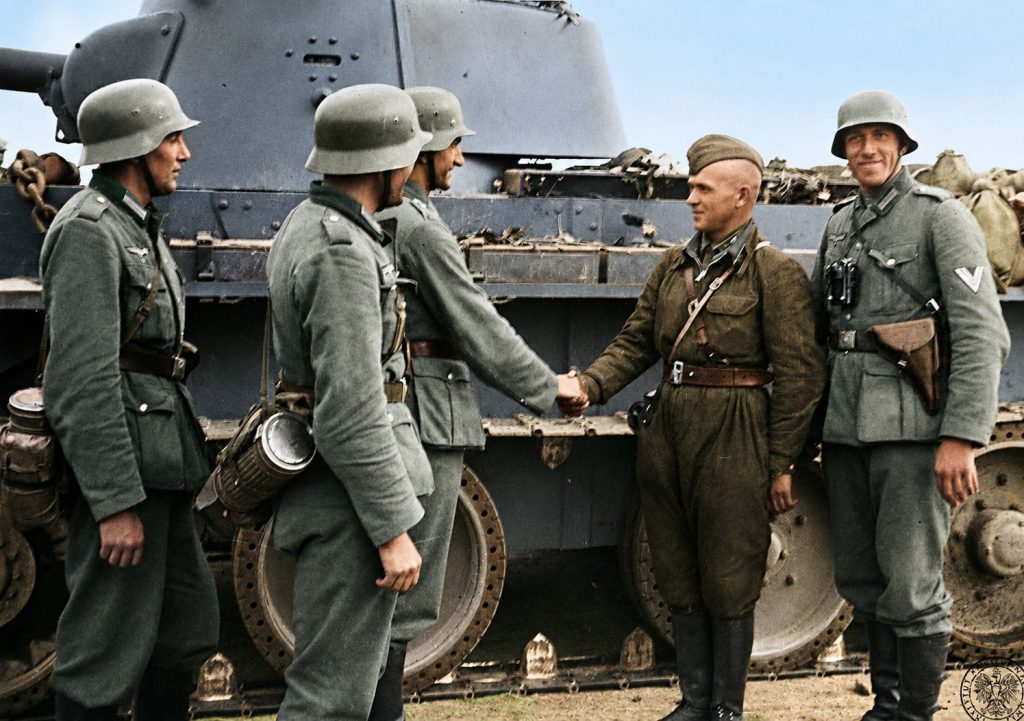
Around 4:00 a.m. on September 17, 1939, units of two Soviet fronts, the Belorussian Front and the Ukrainian Front, crossed Poland’s eastern border in many places. The Soviet side attempted to justify the actual aggression against the Republic of Poland, which had been struggling with the German invasion since September 1, 1939, by citing the disintegration of Polish state structures and the need to “protect” Belarusians and Ukrainians living in Polish territory.
In reality, Soviet dictator Joseph Stalin fulfilled the obligations he had assumed towards the Third Reich in the secret protocol supplementing the non-aggression pact between the Soviet Union and Germany (the so-called Molotov-Ribbentrop Pact of August 23, 1939).
The aforementioned agreement provided for the division of Polish lands between the pacting parties along the Narew, Vistula, and San rivers. The border between the USSR and the Third Reich was adjusted by a treaty signed between the invaders on September 28, 1939. Despite the Soviet side’s incomplete preparation, their superiority in manpower (at least 800,000 Red Army soldiers against up to 250,000 Polish soldiers and other uniformed services) and materiel (including over 4,500 tanks) proved overwhelming. However, where they were able, units of the Polish Army, the Border Protection Corps, and often the civilian population as well, resisted the Soviet aggressor.
On September 20-22, fighting took place for Grodno. Near Szack (September 28-30), subordinates of General Wilhelm Orlik-Rückemann (commander of the Border Protection Corps) dispersed the attacking Soviet units. The Independent Operational Group “Polesie,” commanded by General Franciszek Kleeberg, clashed with the Red Army, including near Milanów (September 30).
The Soviet aggression proved to be a proverbial stab in the back for Poland, which was then preoccupied with the confrontation with Germany. Despite Soviet propaganda, the Polish defense continued, and the military and civilian authorities of the Republic of Poland remained on its territory.
Furthermore, according to currently known German reports (including those from General Heinz Guderian, commander of the German XIX Army Corps), on the eve of the Soviet invasion of Poland, the pace of the German attack slowed noticeably due to a lack of sufficient supplies, including fuel. Furthermore, Warsaw was defending itself (until September 28), and a significant portion of German units were forced to contend with the ongoing Polish offensive initiative known as the Battle of the Bzura (which ended on September 22).
It is therefore very likely that, in the absence of Soviet aggression, the Polish defense would have lasted longer (including based on the so-called Romanian Bridge in the southeastern part of the country), which would have significantly complicated Germany’s international situation. It is possible that such a development would have encouraged the Western powers allied with Poland to undertake more vigorous offensive actions against the Third Reich.
However, this did not happen precisely because of the Soviet invasion of Poland on September 17, 1939, which resulted in its partition between two totalitarian regimes: German and Soviet.
For those eager for knowledge:
I. O. Johnson, The Devil’s Pact. German-Soviet Cooperation and the Causes of the Outbreak of World War II, Poznań 2022
D. Kaliński, The Red Invasion. The Truth About How the Russians Stabbed Us in the Back in September 1939, Krakow 2019
R. Moorhouse, The Devils’ Pact: The Alliance of Hitler and Stalin, Kraków 2022