On September 17, 1939, without a declaration of war, Soviet troops entered the territory of the Republic of Poland. Over the next two weeks, the invaders occupied several eastern voivodeships, with a total area of approximately 200,000 km² and inhabited by over 13 million Polish citizens of various nationalities.
About 40% of the population was Poles, 34% Ukrainians, approximately 8% each of Belarusians and Jews, and about 10% of the population lacked a clearly defined national identity and identified themselves as “locals.” Soviet propaganda emphasized that the invasion was carried out solely to “liberate” the inhabitants of the eastern borderlands of the Republic of Poland from the “oppression of Polish landowners and capitalists.” The word “occupation” was avoided in media reports.
Under a directive from the Military Council of the Belorussian Front, so-called provisional administrations, appointed by military commanders and peasant committees, were organized in the occupied territories. These administrations appropriated land belonging to the so-called landowners and kulaks, distributing it among the poorer inhabitants.
At the same time, Stalinist propagandists ignored a “difficult topic”: the creation and forced membership in collective farms, known as kolkhozes, which deterred those strongly attached to private property. An illusion of voluntariness and respect for the law was created. Stalin decided that Western Belarus and Western Ukraine, as the territories seized from Poland were called, would be incorporated into the Soviet Union after elections were held, during which the population would “express their will” to belong to the so-called Land of Soviets, thus legitimizing the occupation before public opinion worldwide.
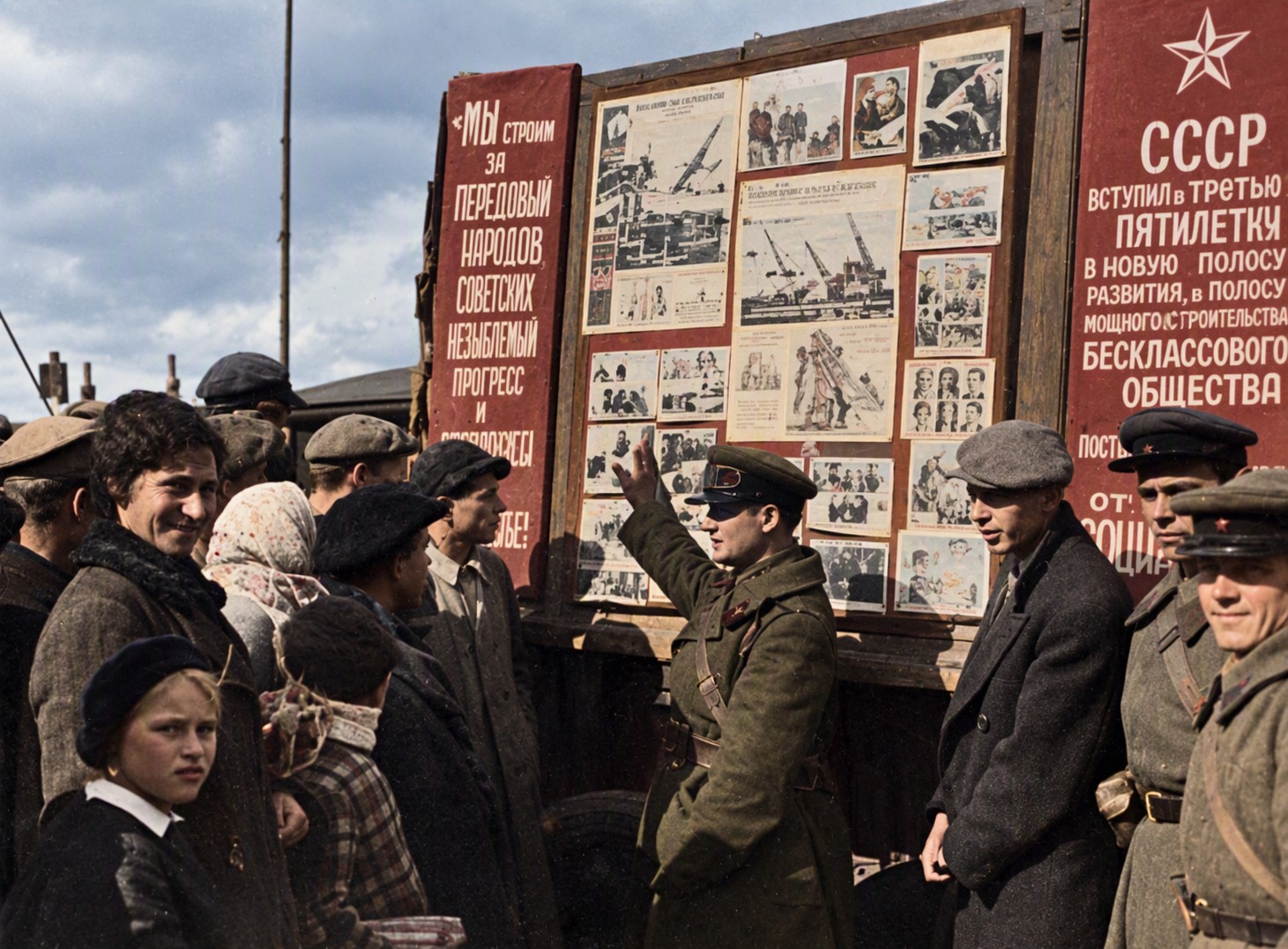
On October 7, 1939, the pre-election propaganda campaign began. The main premise was devoid of democratic principles – only one, top-down delegate to the People’s Assemblies of Western Belarus and Western Ukraine was to be assigned to each electoral district. Each candidate met strict criteria defined by the Soviet authorities – peasants or workers of Belarusian, Ukrainian, or Jewish origin loyal to the communists were promoted; much less often, a candidate with Polish roots, an educated person, or a representative of the intelligentsia could be found on the list.
The Soviets organized numerous rallies and so-called pre-election meetings, constantly agitating against “bourgeois Poland” and the “class exploiters,” as Polish landowners were referred to, disgusting the now-defunct Polish state and Poles. Cities, settlements, and villages were covered with propaganda posters promoting “democratic candidates.” Loudspeakers were installed in the streets and city squares, broadcasting Stalin’s propaganda broadcasts and speeches.
The NKVD and the militia arrested individuals who expressed negative attitudes towards the elections. Officers of these units protected polling stations. It is worth emphasizing that representatives of the legal Polish government, then operating in exile, were aware that the Soviet elections were a farce of democracy and the rule of law.
“The Polish Government is in possession of evidence that a plebiscite was ordered in the Polish territory temporarily occupied by the USSR, which, in accordance with the so-called will of the population, approved the incorporation of these territories into the USSR. The Polish Government declares that ordering such a plebiscite in the occupied territories is inconsistent with the law of nations,” wrote Foreign Minister August Zalewski in a diplomatic note dated October 21, 1939.
The vote took place on Sunday, October 22, 1939. During the elections to the people’s assemblies of Western Belarus, the turnout was 96.7%, and in so-called Western Ukraine – 92.83%. However, in several districts, those promoted by the communist authorities failed to achieve 50% support, and the vote was repeated.
On October 26–28, 1939, in Lviv and on October 28–30, in Białystok, the assemblies approved resolutions requesting the Supreme Soviet of the USSR to annex the so-called Western Ukraine and Western Belarus to the Ukrainian SSR and the Byelorussian SSR. The Soviet authorities expressed their “consent,” and on November 1, 1939, the so-called Western Ukraine became an integral part of the USSR.
A day later, the so-called Western Belarus was incorporated into the Belarusian Soviet Socialist Republic, de facto becoming part of the USSR. On November 14, the former Novgorod and Białystok Voivodeships were incorporated into the Belarusian Soviet Socialist Republic. The following day, the territory of Eastern Lesser Poland and the Volhynia Voivodeship were incorporated into the Ukrainian Soviet Socialist Republic.
The elections to the People’s Assemblies of Western Belarus and Western Ukraine, conducted in violation of democratic standards accepted in the civilized world and completely manipulated, were invalid under international law.
The October plebiscite in the eastern borderlands of the Republic of Poland, seized by Soviet troops, was fraught with negative consequences for its inhabitants. On November 29, 1939, the Supreme Soviet of the USSR granted Soviet citizenship to everyone residing in their territory at the time of the annexation of so-called Western Belarus and Western Ukraine.
The next day, the authorities issued a decree issuing internal passports. Despite its name, the passport did not allow for foreign travel, but rather served as an identity document valid in the USSR and another tool of totalitarian control over its citizens. For over 150,000 Poles, this meant, among other things, compulsory military service in the Soviet army. Passportization also facilitated mass deportations of the Polish population to remote areas of the USSR.
For those eager for knowledge:
D. Boćkowski, Together Forever. The Białystok and Łomża Regions in Soviet Policy during World War II (September 1939 – August 1944), Warsaw 2005
J. Osica, A. Sowa, P. Wieczorkiewicz, 1939. The Last Year of Peace, the First Year of War, Poznań 2009
P. Wieczorkiewicz, Political History of Poland 1935-1945, Poznań 2014
R. Wnuk, “In the Time of the First Soviet.” Polish Conspiracy in the Eastern Borderlands of the Second Polish Republic (September 1939 – June 1941), Warsaw 2007